SikhiAt.Net
Learn Sikhi
A first walk through the house of the Guru.
Nitnem Baani, Panj Kakkaar, and Gurmat Maryada for Sehaj Path — curated guidelines for the Sangat.
These notes are a door, not a finish. Sit with Gurbani. Keep sangat. Let the Guru speak longer than this page.
Ik Onkar
Sikhi begins with One. Ik Onkar names a Creator who is not divided by temple, language, or birth. The Mool Mantar that opens Guru Granth Sahib Ji says this One is True Name, Creator, without fear, without hate, beyond time, unborn, self-existent — known by the Guru’s grace.
From that One, every person stands equal. Rank, caste, and gender do not buy a nearer seat. The work of a Sikh is to remember the Name, earn honestly, and share.
The ten Gurus
Light passed through ten human Gurus, from Guru Nanak Sahib to Guru Gobind Singh Sahib, then into the scripture itself. Guru Nanak Sahib taught the Name, honest work, and sharing. Later Gurus built towns, langar, a script, a throne of the Word, and at last the Khalsa — a people who keep hair, steel, and a clear name before the One.
Guru Gobind Singh Sahib seated Sri Guru Granth Sahib Ji as the living Guru. Sikhs bow to the Word, not to a person on a cushion.
Guru Granth Sahib Ji
Sri Guru Granth Sahib Ji is 1430 angs of shabad — the Guru’s voice in raag, written in Gurmukhi, holding hymns of the Gurus and of bhagats whose longing met the same One. A hukamnama is a command taken from this Guru: a shabad opened for the day or for a question of the heart.
On this site, Sehaj Path will walk those angs in order. Gutka gathers daily banis. The hukam archive holds shabads already kept with the house, shown in Gurmukhi with companion languages.
Naam, work, and sharing
Three strands hold a Sikh day together. Naam Japna is remembrance of the One — with the tongue, the breath, and the work of the hands. Kirat Karni is earning without deceit. Vand Chakna is keeping a portion for others, and sitting in langar where the same plate is set for every guest.
Nitnem is the daily recitation that steadies this. Japji Sahib in the morning, Rehras in the evening, Kirtan Sohila at night, with Jaap, Tav Prasad Savaiye, Chaupai, and Anand Sahib in the complete morning set. The Gutka hall will open those banis from the house files.
The Five Ks
Amritdhari Sikhs keep five articles, each a kakar: kesh (unshorn hair, often with a turban), kangha (a small comb), kara (an iron or steel bangle), kachera (a specific undergarment), and kirpan (a short sword of readiness and mercy). They are not costume. They are a uniform of a sovereign, disciplined life.
Anyone may walk toward this discipline. The door of sangat and langar is not locked by whether the Five Ks are yet kept. Respect is the first seat.
Sangat, pangat, and the gurdwara
A gurdwara is the Guru’s door. Shoes off, head covered, sit on the floor in the darbar while the Guru is present as Granth. After kirtan or hukam, pangat — a line of equals — takes langar. No one is turned away for hunger or for creed.
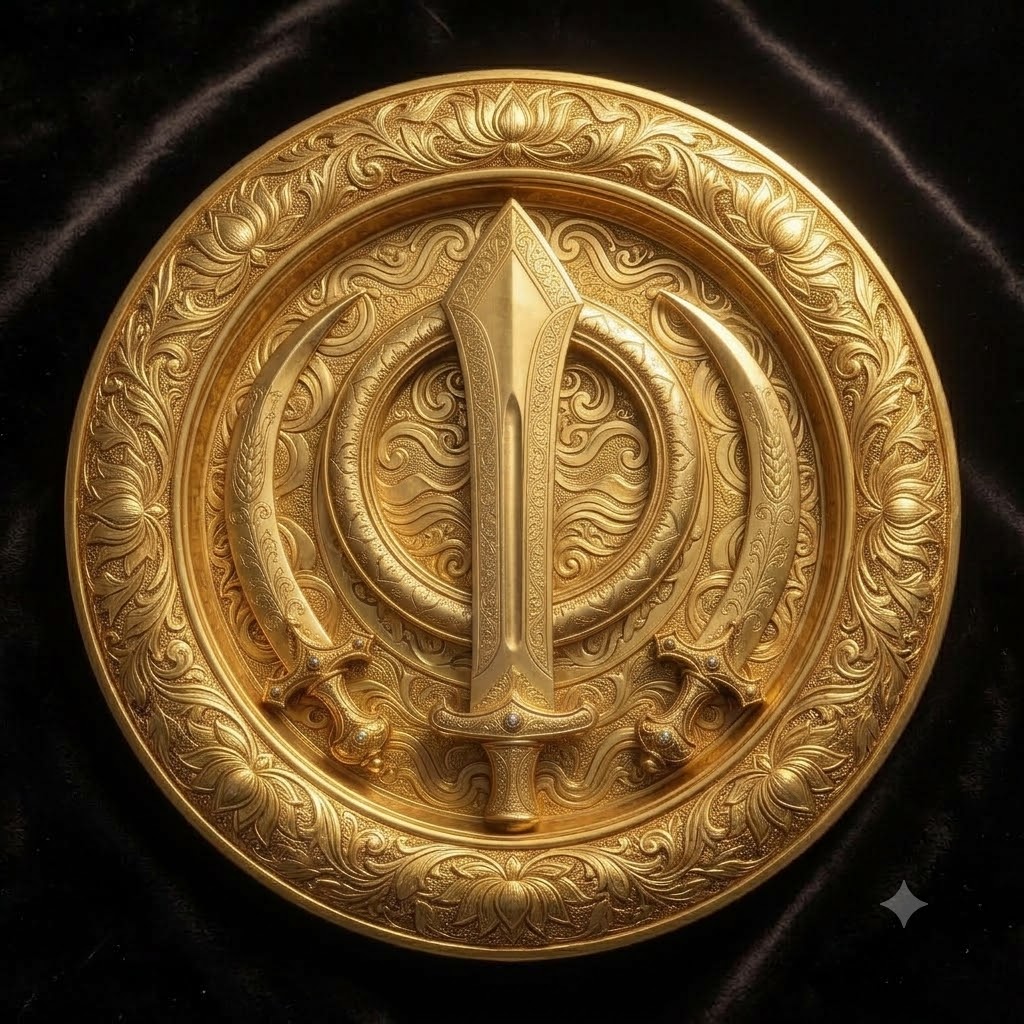
The Khanda on the nishan sahib is a mark of this court: the double-edged sword of truth, the circle of the One, the two kirpans of spiritual and worldly duty held together.
Nitnem
Nitnem is the daily recitation that keeps a Sikh day in order. The morning set is Japji Sahib, Jaap Sahib, Tav Prasad Savaiye, Chaupai Sahib, and Anand Sahib. Rehras Sahib is read in the evening. Kirtan Sohila is read at night. These banis are in the Gutka hall of this court, from the house files — not from another site.
The Five Ks (kesh, kangha, kara, kachera, kirpan) are the uniform of an Amritdhari life. Anyone may sit in sangat and langar before that discipline is kept. Respect is the first seat. See also the Five Ks section above.
Sehaj, Saptahik, and Akhand
This court hosts Sehaj Path: one complete walk of Sri Guru Granth Sahib Ji from ang 1 to 1430. Pause and idle are allowed. The seat lock is the maryada of one voice at a time. Do not skip angs. Bhog is a real close, not a delete.
Saptahik Path is a week-bound complete reading, often in a gurdwara with a roster. This court does not time a seven-day clock and does not pretend to be Saptahik.
Akhand Path is a continuous reading, classically about forty-eight hours, with a relay of readers. This court does not run Akhand Path timing or a 48-hour roster. A Sangat Sehaj Path here may pause. It is not Akhand Path.
Seat maryada
Cover the head. One voice at a time. Do not skip angs. Pause is allowed; idle about a minute (the sevadar may tune it) frees the seat so the next reader may continue. Ardas belongs at the start of a sitting. At bhog: hukamnama, and degh where the house can offer it. Bhog is a close of the path, not a wipe of the record.
Guests may see a public path card. Only a signed-in reader may take the seat. Family (invited) may see who holds it. Listen-along, when the sevadar has switched it on, is reading with the sangat without writing progress.
Ardas, shukrana, chardi kala, Bandi Chhor
Path parameters on a Sangat Sehaj Path are the house’s way of naming why a walk is offered. They are not a second granth.
- Ardas — standing petition before the Guru. On a path, “Ardas for” marks who or what the sitting is held for: healing, a family, the world’s peace, or chardi kala.
- Chardi kala — rising spirits; high morale in the Hukam of the One, even in hardship. It is an ardas value in this court, not a slogan.
- Shukrana — thanks. A path may be shukrana for a hukam received, for anand in the house, or for a safe return.
- Bandi Chhor — the day of release, kept with Diwali, when Guru Hargobind Sahib came out of Gwalior with fifty-two rajas. On a path it maps to gurpurab / observance, not to a private jailbreak story. The calendar of this house marks the day; the path may be dedicated beside it.
Family path and public path as seva
A public path is listed in sangat search. Anyone signed in may wait for the seat and continue when it is idle. Guests may see the card. That listing is seva: the walk is offered to the court, not hidden for credit.
A family path is invited only. It is not in public search. Family sees who holds the seat. The invite is sent to an inbox; this court stores a hash, not the address. Private paths stay with the owner.
Seva here is the reading itself — covered head, one voice, no skipped angs — not a scoreboard of who started the most paths.